
Product & Catalog Updates
Add, revise, or organize supplied product information, variants, pricing, media, and other catalog details so store listings remain aligned with current business requirements.
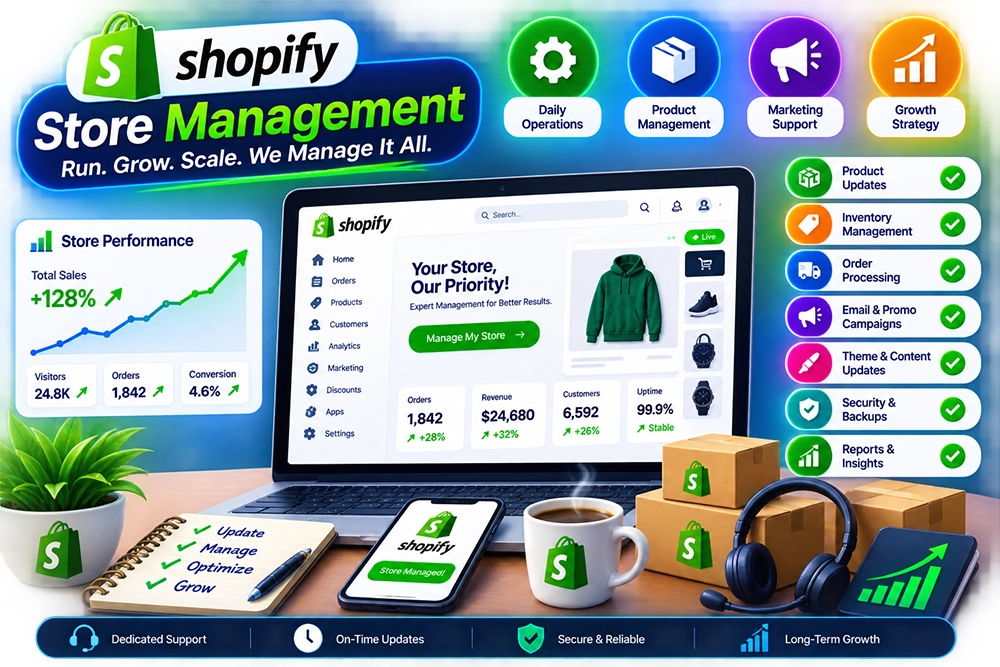
Running a Shopify store involves far more than keeping the website online. Products change, collections need updating, inventory shifts, promotions come and go, content requires maintenance, and operational settings need regular attention as the business evolves.
Our Shopify store management services provide ongoing support for the work that keeps your storefront current and organized. From catalog updates and merchandising to account settings, content changes, and multi-store coordination, we help manage recurring store tasks so your ecommerce operation does not depend on rushed fixes or inconsistent updates.
Store management becomes difficult when everyday updates are handled only when something becomes urgent. Product changes get delayed, collections fall out of date, promotions remain live too long, inventory information becomes harder to coordinate, and small administrative tasks begin consuming time that should be spent on larger commercial priorities.
Ongoing Shopify management creates a more consistent operating rhythm. We handle agreed store tasks across catalog maintenance, content updates, account settings, merchandising, inventory-related changes, and other recurring requirements, giving the storefront a clearer process for staying accurate and up to date.
The exact workload changes from store to store. We focus on the recurring administrative, merchandising, catalog, and storefront tasks that need regular attention to keep the ecommerce environment organized and customer-facing information current.
Add, revise, or organize supplied product information, variants, pricing, media, and other catalog details so store listings remain aligned with current business requirements.
Update collections, featured products, product groupings, and merchandising arrangements to reflect changing campaigns, inventory priorities, seasonal activity, or catalog strategy.
Keep relevant pages, banners, promotional content, navigation, and other storefront information current as offers, messaging, products, and business priorities change over time.
Support agreed inventory-related and operational store updates where Shopify needs to reflect current availability, product changes, fulfillment information, or other supplied business data.
Maintain relevant administrative settings, user access, store information, and agreed configuration updates as the ecommerce operation changes or new requirements are introduced.
Help coordinate recurring updates across multiple Shopify stores where products, content, inventory, merchandising, or operational changes need to remain aligned between storefronts.
Small ecommerce tasks rarely feel urgent on their own, but inconsistent execution can create a storefront that is difficult to maintain. A defined management workflow makes recurring updates easier to prioritize, review, and complete without losing track of what changed and why.
Recurring store tasks are handled against agreed priorities, helping distinguish routine maintenance from work that requires broader development or strategic decisions.
Catalog updates follow a consistent structure so products and collections do not gradually become harder to manage as new inventory is introduced.
Storefront changes are considered in context, reducing the chance that one update creates inconsistent content, navigation, or merchandising elsewhere in the customer experience.
Multi-store requirements can be coordinated more deliberately when shared changes are identified before updates are carried out independently across separate storefronts.
Administrative access and settings changes are handled with clear scope, helping avoid unnecessary modifications to areas that are unrelated to the requested management task.
Ongoing work can reveal recurring operational friction, giving the business clearer signals about where automation, integration, redesign, or development may eventually provide a better solution.
Store management is organized around recurring priorities rather than handled as an open-ended list of changes. We define the areas in scope, receive and review updates, carry out the work, validate important storefront changes, and keep the process ready for the next operating cycle.
We review the current store, recurring management needs, available access, internal responsibilities, and the areas where ongoing support is expected before regular work begins.
Requested updates are organized according to urgency, storefront impact, dependencies, and the agreed management scope so routine work can be handled in a more predictable order.
Approved product, collection, content, merchandising, settings, and other administrative changes are carried out using the information and instructions supplied for each task.
Where updates affect several store areas or multiple storefronts, dependencies are considered so related changes can be coordinated rather than completed as disconnected tasks.
Relevant customer-facing areas are checked after important updates to identify obvious issues in product information, navigation, content presentation, collection structure, or other affected elements.
Completed work feeds into the next management cycle, with recurring requirements, new priorities, and larger issues identified separately when they fall outside routine store administration.
Ongoing store management can cover different responsibilities depending on catalog size, internal resources, number of storefronts, and how frequently products or promotions change. These answers clarify some of the most common service considerations.
The scope can include product and collection updates, storefront content changes, merchandising, relevant store settings, account administration, inventory-related updates, and other recurring tasks agreed for the store.
Yes. Product information, variants, collections, media, pricing, and merchandising-related changes can be handled using the data and instructions you provide as part of the agreed management scope.
Yes. Recurring work can be coordinated across multiple stores where the required access, responsibilities, shared content, catalog relationships, and operational rules are clearly defined.
They can overlap, but store management usually focuses more on recurring ecommerce operations, content, products, merchandising, and administration, while technical maintenance may involve code, integrations, theme issues, or development-related work.
Yes. Store management is intended to work with the existing ecommerce environment. Broader redesign or development would only need to be considered when a requirement falls outside the capabilities or condition of the current setup.
Cost depends on store size, frequency of updates, catalog complexity, number of storefronts, management responsibilities, and the amount of recurring operational work included in the agreed scope.
Tell us which recurring store tasks are taking up your time, from catalog and content updates to merchandising, settings, and multi-store coordination. We can define an ongoing management scope around the areas that need regular attention.