Category & Genre-Based Discovery
Organize books and stationery around genres, subjects, authors, age groups, publishers, formats, brands, product types, or other relevant paths so customers can browse the catalog logically.

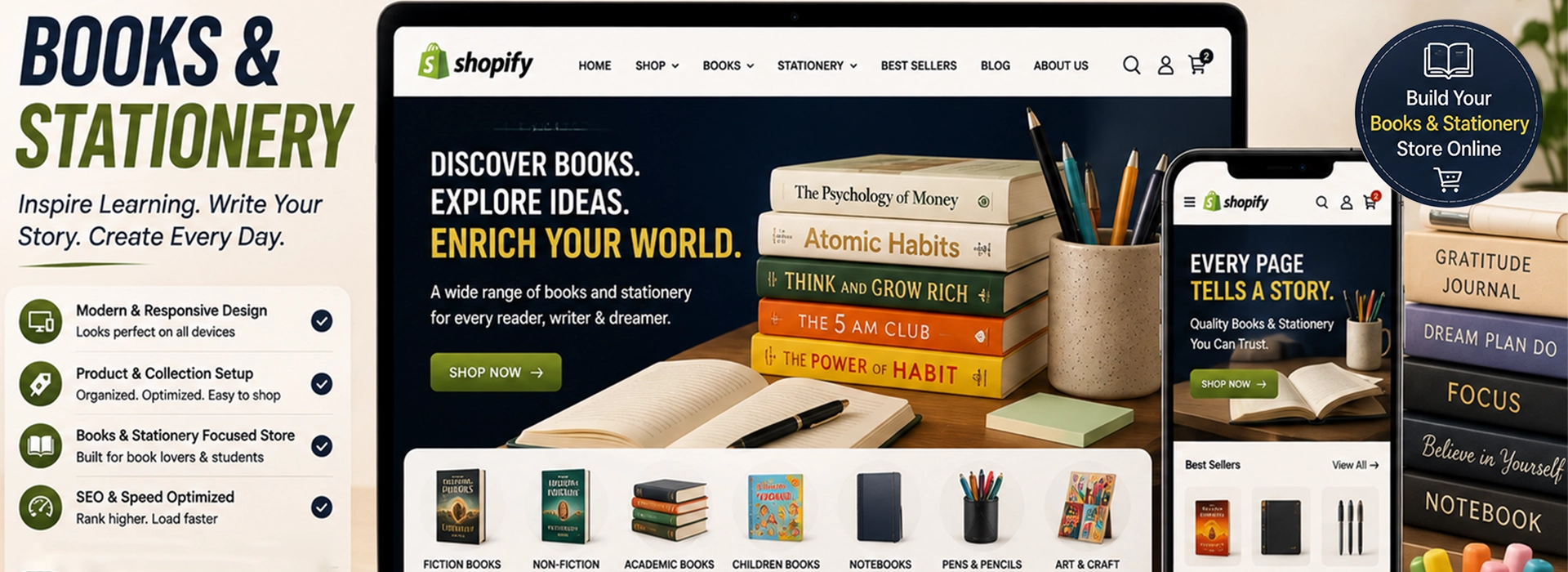
Book and stationery catalogs can grow quickly across genres, authors, publishers, formats, themes, brands, product types, and use cases. Without a clear structure, customers may struggle to locate the exact title or stationery item they already know they want.
Discovery becomes even more important when shoppers are browsing rather than searching for a specific product. Weak filtering, inconsistent metadata, unclear formats, or poorly grouped categories can make related products harder to explore and reduce opportunities for cross-category purchases.
We organize Shopify books and stationery stores around structured product data, meaningful collections, useful search paths, related-product discovery, and responsive shopping journeys that help customers move from interest to purchase with less friction.
This category depends heavily on organization and discoverability. We focus on storefront capabilities that help customers find known products, browse related interests, and explore complementary items more naturally.
Organize books and stationery around genres, subjects, authors, age groups, publishers, formats, brands, product types, or other relevant paths so customers can browse the catalog logically.
Present author, publisher, format, edition, language, dimensions, page count, product specifications, materials, and other relevant details in a clear and consistent layout.
Help customers narrow products using meaningful attributes such as category, author, subject, format, brand, price, age range, product type, or other relevant catalog information.
Create book sets, study packs, stationery kits, gift boxes, themed collections, and complementary product combinations that support easier discovery and higher-value purchases.
Connect books with similar titles, series, authors, genres, and complementary stationery products so browsing can continue beyond the first product page.
Keep search, filtering, product details, collection browsing, related recommendations, and cart actions convenient across smartphones and tablets.
Some customers arrive knowing exactly what they want, while others enjoy exploring categories, recommendations, collections, and new arrivals. A strong storefront should support both behaviors without making either journey difficult.
Help shoppers move through genres, authors, subjects, product types, brands, and stationery categories without relying on a flat product list.
Make format, edition, dimensions, materials, pack details, and other important product information easier to understand before purchase.
Use featured collections, new arrivals, best sellers, themes, seasonal edits, and recommendations to help customers discover products beyond their original search.
Connect books, notebooks, writing tools, art supplies, desk accessories, and gifting products in ways that make complementary purchases feel useful.
Support back-to-school campaigns, festive gifting, reading lists, new releases, stationery launches, and promotional collections without rebuilding the storefront.
Build a Shopify foundation that can accommodate growing titles, additional stationery categories, publishers, brands, variants, and broader ecommerce requirements over time.
A specialist bookstore, school supplies business, and premium stationery brand may share some product types but not the same catalog structure. We begin with the inventory and customer journeys before planning the storefront.
We review your titles, stationery ranges, categories, formats, product attributes, customer groups, merchandising priorities, and ecommerce goals.
Genres, authors, subjects, formats, product categories, brands, filters, collections, and related-product relationships are organized into a clearer discovery structure.
Search, filtering, product details, recommendations, collections, bundles, gifting, and cart journeys are planned around how different customer groups browse and buy.
Approved experiences are configured and developed within Shopify using the required templates, sections, product structures, functionality, and relevant integrations.
Important journeys are reviewed across devices, including search, filtering, collections, product information, recommendations, cart behavior, and other customer-facing interactions.
As new titles, product ranges, seasonal collections, and customer needs are introduced, the store can continue evolving through optimization, maintenance, integrations, and ongoing Shopify development.
Different product categories create different discovery and purchasing requirements. We adapt the storefront around the way customers search, browse, compare, and purchase within each segment.
Structure books around genres, authors, publishers, formats, age ranges, languages, subjects, and recommendations for easier discovery.
Organize school, college, professional, reference, and exam-related titles around subjects, levels, publishers, editions, and customer needs.
Support notebooks, pens, writing tools, filing products, desk supplies, office essentials, and related categories within structured collections.
Organize sketchbooks, drawing materials, craft supplies, writing tools, and creative products by use case, medium, brand, or product type.
Create a more refined shopping experience for journals, writing sets, desk accessories, gift boxes, personalized stationery, and curated collections.
Build a flexible Shopify foundation for publishers and brands launching new products, introducing collections, running campaigns, and expanding direct customer relationships.
Yes. Shopify can support bookstores with extensive catalogs, genres, authors, collections, product information, search, filtering, recommendations, and ecommerce functionality.
Yes. Books can be structured into collections and discovery paths around authors, genres, subjects, age ranges, formats, publishers, or other useful catalog attributes.
Shopify can support substantial catalogs, but consistent product data, collections, search, filtering, and catalog architecture become increasingly important as the number of titles grows.
Yes. Suitable product structures can support writing sets, study kits, stationery bundles, gift boxes, themed collections, and other complementary product combinations.
Yes. Existing stores can be improved across catalog organization, search, filtering, product information, recommendations, mobile usability, merchandising, performance, and customer journeys.
Yes. StoreMintX can support new catalog additions, collection updates, storefront changes, optimization, maintenance, troubleshooting, integrations, and continued Shopify development.