Home About us
All Solutions
All Services
Projects Blog Contact Us

Shopify SEO

Shopify SEO

Shopify SEO Services for Stronger Organic Visibility

Help search engines understand your Shopify store more clearly while making important products, collections, and content easier to discover through organic search. Our Shopify SEO work combines technical review, on-page optimization, catalog structure, internal linking, search data, and content priorities around the pages that matter most to your business.

SEO is treated as an ongoing visibility problem rather than a checklist of metadata changes. We look at how the store is crawled, how pages compete with one another, which search terms match real commercial intent, and where product or collection content needs stronger relevance before recommendations are turned into practical improvements.

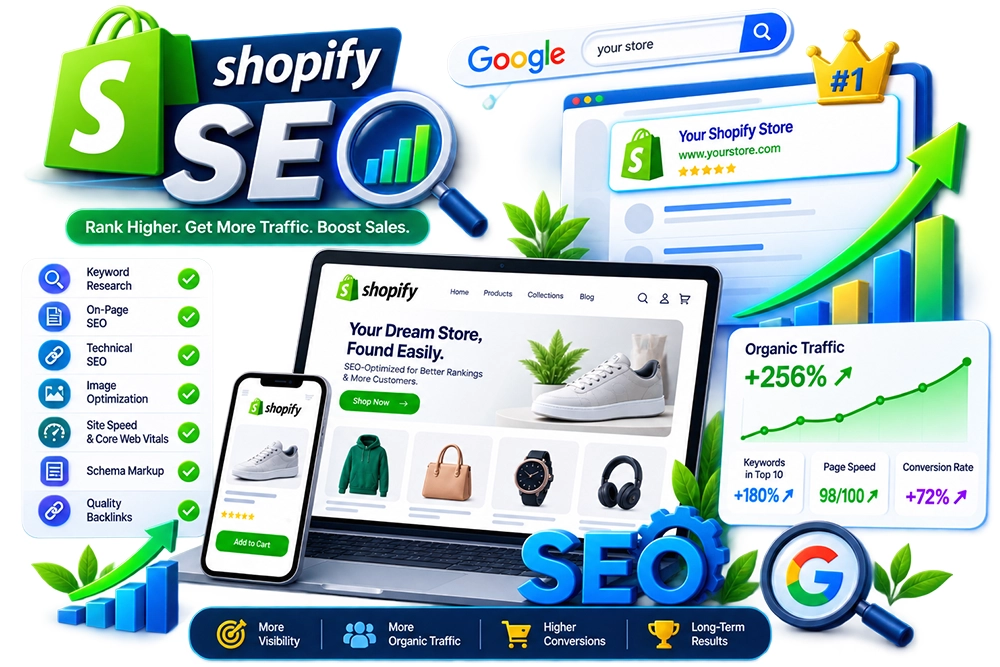
Shopify SEO

Good Products Still Need Clear Signals for Search Engines

Shopify makes it easy to publish products and collections, but that alone does not guarantee search visibility. Duplicate targeting, thin category content, weak internal linking, unclear page intent, technical limitations, poorly structured metadata, or pages competing for similar terms can make it harder for search engines to understand which URLs deserve attention.

Effective SEO starts by deciding what each important page should rank for and how the wider store supports that goal. We review technical signals, search intent, page structure, product and collection relevance, internal linking, and search performance data, then prioritize changes that make the site clearer for both search engines and customers.

SEO Capabilities

Shopify SEO Optimization Across the Store

Organic performance usually depends on several parts of the store working together. We review technical foundations, commercial pages, catalog structure, content relevance, and search data as one connected SEO system rather than optimizing isolated fields.

01

Technical Shopify SEO

Review crawlability, indexation signals, canonical behavior, internal linking, duplicate page risks, structured store architecture, and other technical factors that can influence how search engines discover and interpret the site.

02

Product Page SEO

Improve important product pages around relevant search intent, page titles, content hierarchy, product information, internal links, and other on-page signals without turning descriptions into repetitive keyword blocks.

03

Collection Page SEO

Strengthen collection pages as commercial landing pages by aligning category intent, supporting copy, metadata, product grouping, navigation context, and internal linking with the searches customers use to discover product ranges.

04

On-Page SEO Optimization

Refine page titles, headings, metadata, content structure, keyword targeting, and contextual relevance across priority URLs while keeping the copy readable and aligned with the purpose of each page.

05

Keyword & Content Mapping

Assign meaningful search themes to the right products, collections, service pages, and supporting content so several URLs do not unintentionally compete for the same commercial query.

06

Search Console & SEO Monitoring

Use available search performance data to understand impressions, queries, pages, indexing patterns, and visibility changes, helping ongoing SEO decisions rely on actual search behavior rather than assumptions alone.

Search Strategy

Optimize Pages for Intent Before Optimizing Them for Keywords

Search volume is useful, but a high-volume term is not automatically the right target for every page. We look at what the searcher expects to find, which URL is best suited to answer that need, and how the rest of the site should support it before deciding where keywords belong.

Keyword decisions are made at page level so primary, secondary, and supporting terms have clear destinations instead of being spread across the entire store without structure.

Cannibalization is considered when related products, collections, blogs, and service pages target similar searches, helping clarify which URL should carry the strongest relevance.

Product and collection optimization is based on commercial search intent rather than adding keywords simply because a research tool reports search volume.

Technical findings are connected with page-level SEO so crawl, indexation, content, and internal-linking decisions support the same search strategy instead of being handled separately.

Content is written for customers first, with keywords introduced where they clarify relevance rather than repeated until the copy becomes unnatural or difficult to read.

Search performance is reviewed over time because organic visibility changes as pages, competitors, search demand, and the store itself continue to evolve.

SEO Workflow

How We Approach SEO for a Shopify Store

Shopify SEO begins with understanding the site and its search opportunities before changing individual pages. We review technical foundations, map keywords to URLs, prioritize commercial opportunities, implement improvements, and use search data to guide the next round of work.

01

Store & Search Visibility Review

We examine the current site structure, important products and collections, existing search visibility, technical conditions, and available performance data to establish the starting point.

02

Keyword & Intent Mapping

Relevant search terms are grouped by intent and assigned to suitable URLs, with overlaps identified before optimization begins so pages have clearer individual ranking objectives.

03

Technical SEO Improvements

Priority technical issues affecting crawlability, indexation, duplicate targeting, internal architecture, or search interpretation are addressed according to their likely impact on the store.

04

Page & Catalog Optimization

Priority products, collections, and other commercial pages are refined around their assigned search intent, including headings, metadata, content, internal links, and page-level relevance.

05

Content & Internal Linking Support

Supporting content opportunities and internal links are planned where they can strengthen topical relationships, answer useful searches, and direct relevance toward important commercial URLs.

06

Performance Review & Iteration

Search impressions, query patterns, page visibility, and other available SEO signals are reviewed after implementation so future priorities can be adjusted according to actual search performance.

Shopify SEO FAQ

Questions About SEO for Shopify Stores

Shopify SEO often raises questions about technical limitations, product and collection pages, keywords, Search Console, content, and the time required to build organic visibility. These answers cover several of the practical issues store owners usually consider.

Can Shopify stores be optimized for SEO?

Yes. Shopify stores can be optimized across technical structure, product and collection pages, metadata, content, internal linking, search intent, and other areas that influence how pages are discovered and understood in organic search.

What is included in Shopify SEO services?

Scope can include technical SEO review, keyword research and mapping, product and collection optimization, on-page SEO, internal linking, Search Console review, content recommendations, and ongoing search performance analysis.

Do Shopify product pages need individual SEO?

Priority product pages can benefit from individual optimization when they match meaningful search demand. The right approach depends on the product, competition, page uniqueness, catalog structure, and whether another URL better matches the same search intent.

Are Shopify collection pages important for SEO?

Yes. Collection pages can serve as valuable commercial landing pages because they group related products around broader buying intent. Their usefulness depends on structure, relevance, content quality, internal linking, and the search demand behind the category.

Can Google Search Console be used with Shopify?

Yes. Google Search Console can provide useful information about queries, impressions, pages, indexation, and other search signals that can support ongoing Shopify SEO analysis and troubleshooting.

How long does Shopify SEO take to show results?

There is no fixed timeline because organic performance depends on the current site, competition, search demand, technical condition, content, authority, and the changes being implemented. SEO should be evaluated over time rather than treated as an immediate ranking fix.

Want More Qualified Organic Traffic to Your Shopify Store?

Share your Shopify store, priority products or collections, and the search terms you want to compete for. We can review your current visibility, map the right keywords to the right pages, and identify the technical and on-page SEO work worth prioritizing.