Vehicle-Based Product Discovery
Help shoppers narrow products using relevant vehicle criteria such as make, model, year, variant, or other catalog-specific attributes before they spend time reviewing unsuitable options.

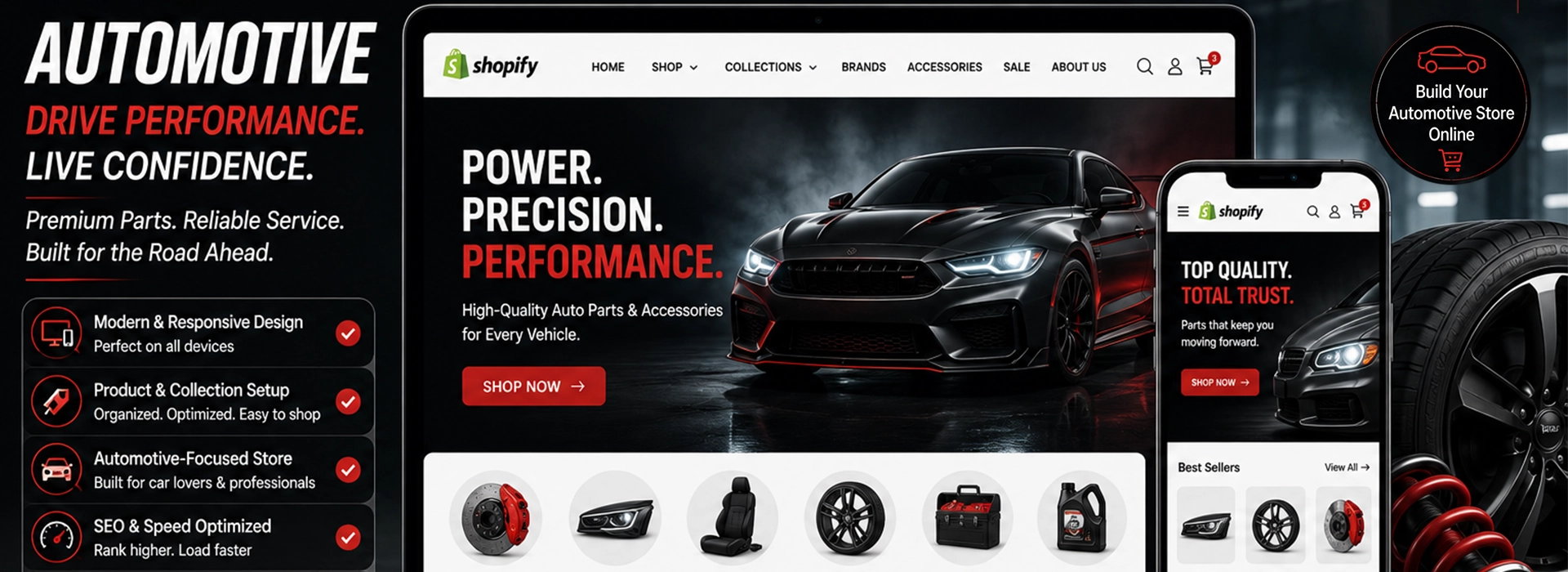
Automotive ecommerce creates a challenge that many conventional product catalogs do not have: a product can look correct while still being unsuitable for a customer's vehicle. Make, model, year, variant, engine, dimensions, specifications, and installation requirements may all affect compatibility.
When those details are buried in descriptions or customers have to search through hundreds of similar listings, the buying process becomes frustrating. Uncertainty can lead to abandoned purchases, unnecessary support questions, and avoidable product-selection mistakes.
A better storefront connects vehicle information with product discovery from the beginning. We structure Shopify automotive stores so shoppers can narrow the catalog intelligently, understand fitment, compare important specifications, and move toward suitable products with greater confidence.
Automotive stores need to manage technical information without making the shopping experience feel technical. We combine structured product data, practical navigation, fitment guidance, and merchandising to help customers reach relevant products efficiently.
Help shoppers narrow products using relevant vehicle criteria such as make, model, year, variant, or other catalog-specific attributes before they spend time reviewing unsuitable options.
Present compatibility information where customers need it, helping them understand whether a part or accessory is intended for their vehicle before adding it to the cart.
Structure dimensions, materials, part references, specifications, installation notes, package contents, warranty information, and other important product details for easier evaluation.
Build useful filtering around product type, vehicle attributes, brand, price, specifications, application, or other relevant characteristics instead of relying on broad categories alone.
Connect complementary components, replacement items, installation accessories, maintenance products, and relevant upgrades to create more useful product relationships.
Keep vehicle selection, filters, fitment details, specifications, product imagery, and purchase actions accessible for customers researching parts directly from a phone or tablet.
Automotive customers often know their vehicle but not the exact product reference they need. A well-structured store should bridge that gap, helping shoppers move from vehicle details and requirements to a compatible product without unnecessary guesswork.
Put vehicle suitability at the center of discovery so customers can concentrate on products that are relevant to their requirements.
Make technical details easier to scan and compare without forcing shoppers to extract important information from long descriptions.
Structure extensive parts and accessories ranges with logical categories, attributes, filters, and product relationships that remain manageable as inventory expands.
Surface complementary parts, installation items, replacement components, maintenance products, and upgrades at useful points in the customer journey.
Bring compatibility, specifications, product imagery, installation information, policies, and other decision-making details together before the customer reaches checkout.
Prepare the storefront for additional vehicle ranges, brands, product categories, integrations, inventory requirements, and changing automotive ecommerce operations.
An accessories brand with a focused catalog needs a different structure from a retailer managing thousands of vehicle-specific parts. Our approach starts by understanding how your products relate to vehicles, how customers search for them, and what information is necessary for a confident purchase.
We examine product categories, vehicle relationships, attributes, specifications, variants, brands, existing data, customer types, and operational requirements.
We determine how vehicle selection, collections, search, filtering, compatibility information, and product relationships should work together throughout the shopping journey.
Product pages are structured to balance technical specifications, fitment guidance, imagery, purchasing information, related products, and calls to action without overwhelming the customer.
The planned experience is configured and developed within Shopify using suitable templates, sections, catalog structures, functionality, and integrations required by the project.
We review important customer paths across devices, including vehicle selection, filtering, product information, compatibility presentation, cart interactions, and other critical storefront behavior.
New vehicle ranges, products, brands, integrations, and operational requirements can be incorporated as the business develops, allowing the storefront to evolve alongside the catalog.
Compatibility and purchasing behavior vary considerably across automotive categories. The storefront structure should reflect whether customers are replacing a component, maintaining a vehicle, upgrading performance, or purchasing accessories.
Organize replacement and mechanical parts around vehicle compatibility, part attributes, specifications, brands, and relevant technical details.
Create clear journeys for interior, exterior, convenience, protection, styling, travel, and vehicle-specific accessories.
Present performance components with suitable specifications, compatibility details, supporting parts, and application information for more informed purchasing.
Structure cleaners, detailing products, tools, protection products, kits, and consumables around application and maintenance requirements.
Support specification-heavy shopping experiences where dimensions, vehicle suitability, product attributes, and compatibility play an important role in selection.
Build a focused Shopify storefront for brands selling their own automotive products while retaining flexibility for new ranges, vehicle applications, campaigns, and market expansion.
Yes. Shopify can support automotive catalogs containing parts, accessories, variants, technical specifications, collections, product relationships, and additional functionality required for vehicle-focused ecommerce.
Vehicle-based product discovery can be implemented when suitable product and compatibility data is available. The exact approach depends on the catalog structure and project requirements.
Yes. Fitment and compatibility information can be incorporated into the storefront using an appropriate data structure and implementation for the automotive catalog.
Shopify stores can be structured for extensive catalogs using collections, product attributes, filtering, search, structured information, and suitable integrations where required.
Yes. Existing automotive stores can be improved across navigation, fitment discovery, filtering, product information, mobile usability, merchandising, performance, and purchasing journeys.
Yes. StoreMintX can support catalog changes, new product ranges, storefront improvements, technical troubleshooting, integrations, maintenance, optimization, and continued Shopify development.