
Company Accounts & Buyer Access
Structure B2B customer access around companies, purchasing relationships, and account requirements so the right buyers can interact with the appropriate commercial experience.
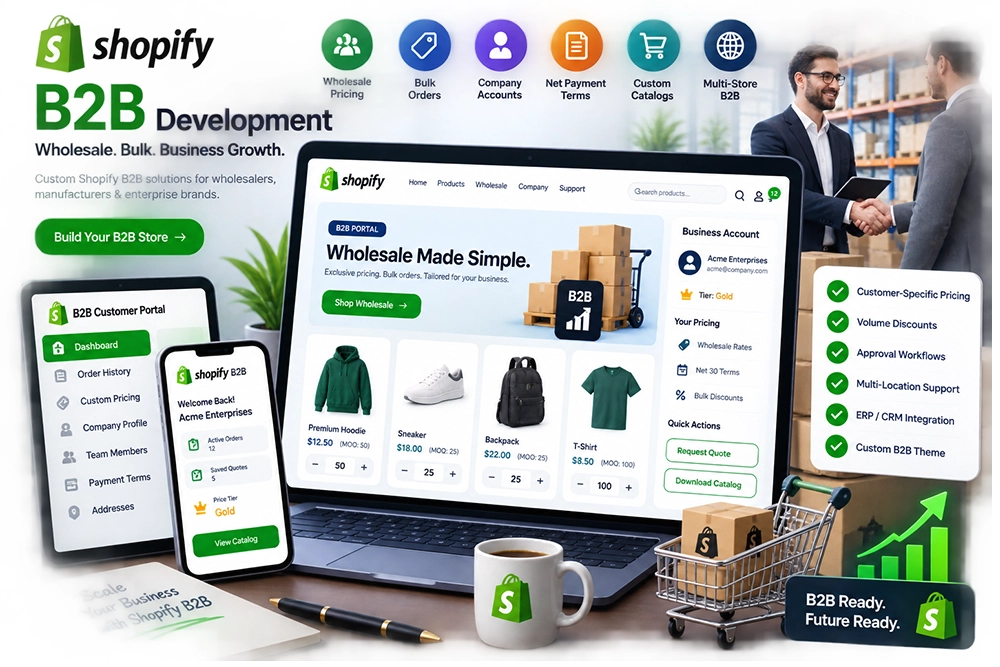
Selling to businesses introduces requirements that rarely exist in a conventional consumer storefront. Buyers may need company accounts, negotiated pricing, purchasing permissions, tailored catalogs, larger order workflows, payment terms, and an ordering experience designed around repeat procurement rather than one-time purchases.
Shopify B2B development brings these requirements into a structured ecommerce environment built around the way your wholesale operation actually works. From the buyer-facing storefront to account logic, integrations, ordering workflows, and back-office processes, we develop B2B experiences that make purchasing easier for customers while keeping day-to-day commerce manageable for your team.
Traditional B2B ordering can involve spreadsheets, emails, phone calls, manual price checks, account-specific terms, and repeated coordination between buyers and sales teams. As order volume grows, these disconnected processes can slow purchasing and create unnecessary administrative work.
A thoughtfully developed Shopify B2B environment moves more of that experience into a structured digital workflow. We shape the storefront around buyer relationships, purchasing rules, product access, pricing requirements, order behavior, and connected business systems so customers can complete routine transactions with less friction.
Every wholesale operation has its own combination of customers, catalogs, pricing structures, purchasing rules, and internal processes. Our development scope is shaped around those commercial realities instead of forcing every buyer through the same retail-style journey.
Structure B2B customer access around companies, purchasing relationships, and account requirements so the right buyers can interact with the appropriate commercial experience.
Configure purchasing experiences around relevant pricing and product availability where different customer groups require distinct commercial terms or catalog access.
Create ordering journeys suited to repeat and higher-volume purchasing, reducing unnecessary steps between product selection, account review, cart management, and order completion.
Develop a customer-facing B2B commerce experience where business buyers can access relevant products, account information, purchasing options, and ordering functionality from one structured environment.
Connect the commerce environment with appropriate ERP, CRM, inventory, fulfillment, accounting, or other operational systems when data needs to move between Shopify and the wider business.
Shape navigation, product discovery, account interactions, ordering interfaces, and responsive layouts around professional buyers who value speed, clarity, and efficient repeat purchasing.
Business buyers behave differently from typical retail shoppers. Development therefore needs to consider who is purchasing, what they are allowed to buy, which commercial terms apply, how orders are processed, and what happens to transaction data after an order enters the business.
Buyer journeys are planned around recurring purchasing behavior rather than simply adapting a consumer storefront and expecting wholesale customers to work around its limitations.
Account, pricing, catalog, and purchasing requirements are considered together so the storefront reflects the commercial relationship between your business and each type of customer.
B2B ecommerce web design decisions prioritize fast product access, clear information, efficient ordering, and usability for buyers who may return frequently to place substantial orders.
Integration planning considers where customer, inventory, pricing, product, and order information originates so unnecessary duplication and manual handling can be reduced.
Development is approached with ongoing merchant operations in mind, helping internal teams manage customers and commerce without turning routine changes into development projects.
The underlying structure is planned for changing catalogs, new buyer groups, additional workflows, and evolving B2B requirements as the digital sales operation becomes more established.
A B2B build starts with commercial rules and operational reality before technical implementation. We identify buyer types, purchasing requirements, data dependencies, system connections, and storefront journeys first, then translate them into a practical development plan.
We examine customer types, sales processes, catalogs, pricing relationships, ordering patterns, internal workflows, existing technology, and the objectives behind moving more B2B commerce online.
Buyer access, product discovery, pricing, purchasing rules, checkout requirements, order handling, and relevant post-order processes are mapped before the technical structure is finalized.
We define how storefront interfaces, customer accounts, catalogs, commercial rules, integrations, and data responsibilities should work together across the proposed B2B ecommerce environment.
Approved storefront components, B2B functionality, workflows, and required system connections are implemented according to the agreed technical and commercial requirements.
Key scenarios are reviewed across account access, product visibility, pricing behavior, purchasing journeys, responsive layouts, integrations, and order flows before release.
Once the environment is validated, it is prepared for launch. Future buyer groups, integrations, workflows, and commerce capabilities can then be introduced as operational requirements evolve.
B2B ecommerce projects involve more than choosing a storefront design. Account structures, commercial rules, integrations, catalogs, ordering behavior, and existing business processes all influence the development scope.
Shopify B2B development focuses on creating ecommerce experiences for business buyers, including requirements involving company accounts, customer-specific purchasing experiences, catalogs, pricing structures, workflows, integrations, and wholesale ordering.
Shopify can support business-to-business selling, but the appropriate setup depends on the required customer structure, pricing model, catalog rules, purchasing process, integrations, and the Shopify plan and capabilities selected for the project.
Different B2B purchasing experiences can be structured around customer and company requirements where the selected Shopify configuration supports the required pricing, catalog, and account capabilities.
Integrations may be developed where suitable APIs or integration methods are available. The exact approach depends on the systems involved, required data flows, synchronization rules, and operational processes.
In some implementations B2B and direct-to-consumer requirements can coexist, while other businesses benefit from a different storefront or operational structure. The right approach depends on customer experience, catalog, pricing, branding, and workflow requirements.
Cost varies with account complexity, pricing and catalog requirements, storefront scope, custom workflows, integrations, data requirements, testing, and the condition of the existing ecommerce environment.
Tell us how your customers order today, where manual work slows the process, and which systems support your sales operation. We can turn those requirements into a Shopify B2B development plan built around your buyers and internal workflows.