Customer-Specific Pricing
Structure pricing experiences around approved customer groups, wholesale tiers, negotiated rates, volume requirements, or other commercial rules relevant to the B2B model.

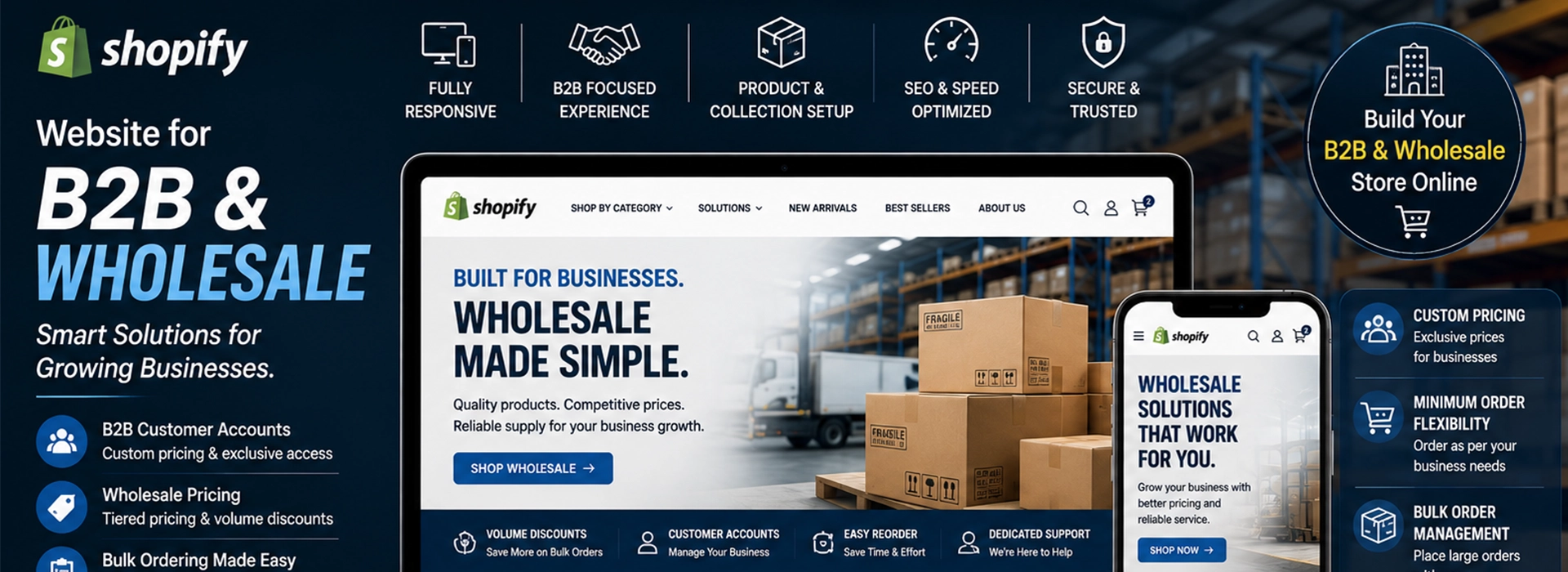
Wholesale purchasing usually involves more than adding a few items to cart. Buyers may need approved accounts, customer-specific catalogs, larger order quantities, volume pricing, payment terms, purchase-order references, repeat orders, and internal approval processes before an order is complete.
When those requirements are handled through manual workarounds, email orders, spreadsheets, or a storefront designed only for consumers, operations become harder to scale. Customers also spend more time asking for information that should already be available within their account or ordering experience.
We structure Shopify B2B and wholesale stores around account-based commerce. Pricing, catalogs, ordering, customer access, operational workflows, integrations, and repeat purchasing are planned together so the storefront can support both customer convenience and internal efficiency.
Business buyers value speed, accuracy, and predictable purchasing. We focus on capabilities that reduce unnecessary manual handling while giving approved customers the information and ordering tools they need.
Structure pricing experiences around approved customer groups, wholesale tiers, negotiated rates, volume requirements, or other commercial rules relevant to the B2B model.
Control which products, collections, or price structures are visible to different customer groups where the business does not want every buyer to see the same catalog.
Make larger orders easier with quantity-focused buying journeys, repeat ordering, faster product selection, and practical workflows designed for customers purchasing multiple SKUs at once.
Support account-based experiences for approved buyers, including relevant company information, customer access, ordering history, and other account-level requirements.
Structure the purchase journey around agreed B2B requirements such as minimum quantities, payment terms, order references, shipping rules, and other operational conditions where supported by the chosen setup.
Connect Shopify with relevant business systems where product data, customer records, inventory, pricing, orders, or fulfillment information needs to move between platforms.
B2B ecommerce works best when customers can complete routine purchases independently while your team retains control over pricing, access, catalog rules, order conditions, and operational workflows.
Give approved customers a more relevant experience based on their account, pricing structure, catalog access, and ordering requirements.
Make frequent purchasing more efficient for customers who already know what they need and want to reorder without repeating a consumer-style journey.
Support different customer groups, pricing arrangements, product access, volume requirements, and operational rules where the business model requires more than one standard retail offer.
Organize extensive product ranges so professional buyers can search, filter, compare, and order using the product information that matters to their purchasing process.
Reduce duplicate administration by considering how ecommerce orders, customers, pricing, stock, and fulfillment need to interact with existing business systems.
Establish a Shopify foundation that can support additional business customers, new catalogs, markets, integrations, purchasing rules, and operational complexity as wholesale activity grows.
Wholesale requirements can vary widely between manufacturers, distributors, suppliers, and brands. We start by understanding commercial rules and operational workflows before deciding how the storefront should behave.
We review customer types, pricing arrangements, catalogs, order sizes, payment conditions, fulfillment workflows, internal systems, and current manual processes.
Customer access, product visibility, price structures, company accounts, collections, and other B2B rules are mapped into an organized commerce model.
We plan bulk ordering, repeat purchasing, quantity selection, account journeys, payment requirements, and other buying steps around the needs of professional customers.
The approved B2B experience is configured and developed within Shopify using suitable account, catalog, pricing, ordering, and integration capabilities for the agreed scope.
Important scenarios are reviewed across customer groups, product access, pricing, ordering, account behavior, integrations, and other relevant B2B journeys before launch.
As customer groups, catalogs, terms, integrations, and markets expand, the Shopify B2B environment can continue evolving alongside the wider wholesale operation.
Different B2B businesses require different levels of pricing control, catalog segmentation, account management, ordering flexibility, and operational integration. We adapt the storefront around the commercial model.
Create direct ordering experiences for approved business customers with relevant product catalogs, account pricing, bulk quantities, and connected operational workflows.
Support large multi-brand catalogs, customer groups, extensive product data, inventory requirements, repeat orders, and high-volume purchasing.
Provide trade customers with dedicated pricing, product access, case quantities, ordering rules, and account experiences while maintaining stronger control over the brand.
Structure consumer and business buying journeys within an appropriate commerce setup where retail and wholesale customers require different pricing, access, or ordering experiences.
Plan business selling across regions where catalogs, pricing, currencies, customers, logistics, or other commercial requirements differ between markets.
Build a more connected Shopify environment for businesses managing larger customer bases, complex catalogs, system integrations, and evolving operational requirements.
Yes. Shopify can support B2B and wholesale commerce with suitable account, catalog, pricing, ordering, and operational functionality. The appropriate setup depends on the business requirements and Shopify plan or capabilities being used.
Customer-specific or group-based pricing can be structured where supported by the selected Shopify setup. The right approach depends on pricing rules, customer groups, catalogs, and commercial requirements.
Product and catalog visibility can be planned around customer groups where the chosen Shopify configuration supports segmented B2B experiences and the business requires controlled product access.
Yes. Appropriate storefront functionality can make larger-quantity and repeat ordering more efficient, depending on catalog structure, purchasing workflows, and B2B requirements.
Shopify can be integrated with external systems where suitable APIs, connectors, or custom integration approaches are available. The scope depends on the systems and data that need to be synchronized.
Yes. Existing B2B stores can be improved across customer accounts, catalogs, product discovery, pricing presentation, ordering workflows, integrations, mobile usability, and operational efficiency.