Room & Category-Based Discovery
Organize products around living rooms, bedrooms, dining spaces, offices, outdoor areas, decor categories, styles, or other relevant paths so customers can shop according to how they think about their space.

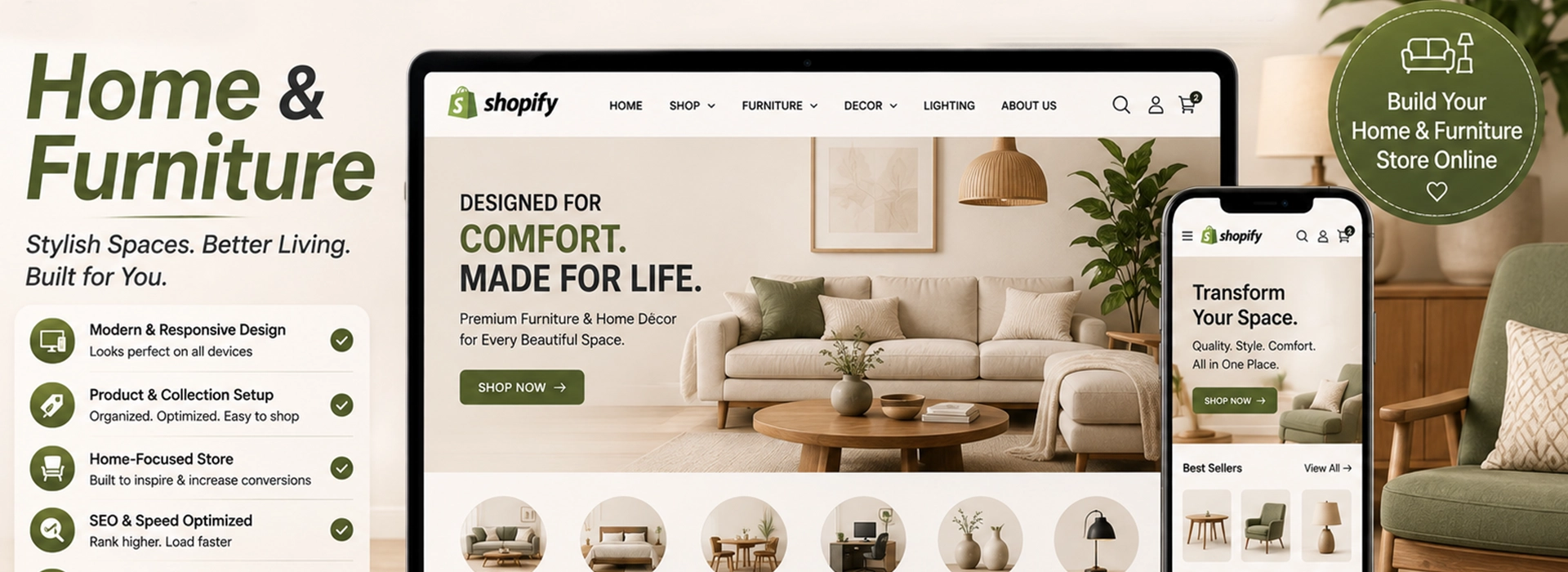
Furniture and home products are often judged in context. Customers want to know whether an item will fit the room, match an existing style, coordinate with other pieces, and arrive in a way that works for their location and schedule.
When dimensions are buried, finishes are unclear, related products are difficult to find, or delivery information appears too late, the buying journey becomes harder than it needs to be. Larger catalogs can add even more friction when shoppers cannot move easily between rooms, styles, materials, and product types.
We organize Shopify home and furniture stores around confident decision-making. Clear product details, room-based discovery, visual merchandising, material and finish options, delivery guidance, and responsive journeys help customers evaluate products while giving the store a structure that can grow with the catalog.
Home commerce works best when visual inspiration and practical information support each other. We focus on the storefront capabilities that help customers discover suitable products, understand important specifications, and make larger purchase decisions with less uncertainty.
Organize products around living rooms, bedrooms, dining spaces, offices, outdoor areas, decor categories, styles, or other relevant paths so customers can shop according to how they think about their space.
Present dimensions, materials, finishes, weight, care instructions, assembly information, package details, and other practical specifications in a format that supports confident product evaluation.
Structure relevant variants such as upholstery, wood finish, size, color, configuration, or other product options so customers can understand available choices clearly before purchase.
Connect complementary furniture, decor, lighting, textiles, and accessories so customers can discover matching or related pieces and build a more complete room or style.
Give delivery expectations, shipping conditions, assembly guidance, lead times, and other practical information appropriate visibility so customers understand what happens after purchase.
Keep imagery, dimensions, specifications, variant choices, delivery information, and related product discovery easy to use across smartphones and tablets.
Home and furniture stores need to inspire without hiding the practical information that makes a purchase possible. Strong ecommerce experiences give visual presentation and product detail equal importance throughout the buying journey.
Help customers shop by room, style, category, material, or use case instead of forcing every shopper through a flat catalog structure.
Make dimensions, materials, finishes, care, assembly, and delivery information easier to find so customers can evaluate whether a product fits their needs.
Use collections, lifestyle imagery, featured ranges, coordinated products, and editorial sections to help customers discover products in a more inspiring context.
Connect furniture with complementary decor, lighting, textiles, and accessories so shoppers can move naturally between related parts of the catalog.
Surface practical delivery, lead-time, assembly, and service information earlier in the purchase journey so large-item buying feels more predictable.
Build a Shopify foundation capable of supporting new collections, additional product configurations, larger catalogs, integrations, and broader operational requirements over time.
Furniture, decor, and homeware businesses can have very different catalogs and customer journeys. We start by understanding how products are grouped, what information customers need, and how purchasing decisions are made before planning the storefront.
We review your product range, rooms, categories, materials, finishes, variants, customer profiles, delivery requirements, merchandising priorities, and ecommerce goals.
Categories, room-based collections, product specifications, filters, related products, variants, and supporting information are organized into a clearer catalog structure.
We plan how customers move between inspiration, collections, product details, options, complementary products, delivery information, and other important purchase steps.
Approved experiences are configured and developed within Shopify using the required templates, sections, product structures, functionality, and relevant integrations.
Important journeys are reviewed across devices, including collections, imagery, specifications, variants, related products, delivery information, cart behavior, and other customer-facing interactions.
As new collections, styles, products, and operational requirements are introduced, the store can continue evolving through optimization, maintenance, integrations, and ongoing Shopify development.
Different home categories create different browsing, specification, and delivery requirements. We adapt the storefront structure around how customers evaluate each type of product.
Structure sofas, tables, chairs, storage, beds, and other large products around dimensions, materials, finishes, configurations, and delivery information.
Create visually led discovery for decor collections, accessories, wall pieces, decorative objects, and seasonal ranges across different styles and rooms.
Present dimensions, materials, finishes, bulb requirements, installation considerations, styles, and related products within clear shopping journeys.
Support bedding, rugs, curtains, cushions, throws, and related products with size, material, color, care, and coordinated collection options.
Balance refined visual presentation with detailed specifications, craftsmanship, collection storytelling, and a more considered buying experience.
Build a flexible Shopify foundation for growing brands adding new categories, launching collections, expanding merchandising, and entering additional markets.
Yes. Shopify can support furniture and home brands with large product catalogs, variants, detailed specifications, collections, merchandising, integrations, and scalable ecommerce functionality.
Yes. Product templates can be structured to display dimensions, materials, finishes, weight, care details, assembly information, package specifications, and other relevant product data.
Yes. Where the product structure supports them, options such as size, color, upholstery, material, finish, configuration, and other variants can be presented within the product experience.
Yes. Products can be organized into room-based, style-based, category-based, or other relevant collections depending on how customers are expected to browse the catalog.
Yes. Existing stores can be improved across catalog structure, product information, visual merchandising, mobile usability, delivery messaging, related-product discovery, performance, and customer journeys.
Yes. StoreMintX can support ongoing requirements including new collections, storefront updates, optimization, maintenance, troubleshooting, integrations, catalog changes, and continued Shopify development.