
Custom Shopify App Development
Build store-specific applications around workflows, business rules, operational needs, or functionality that cannot be handled cleanly through native Shopify settings or off-the-shelf applications.
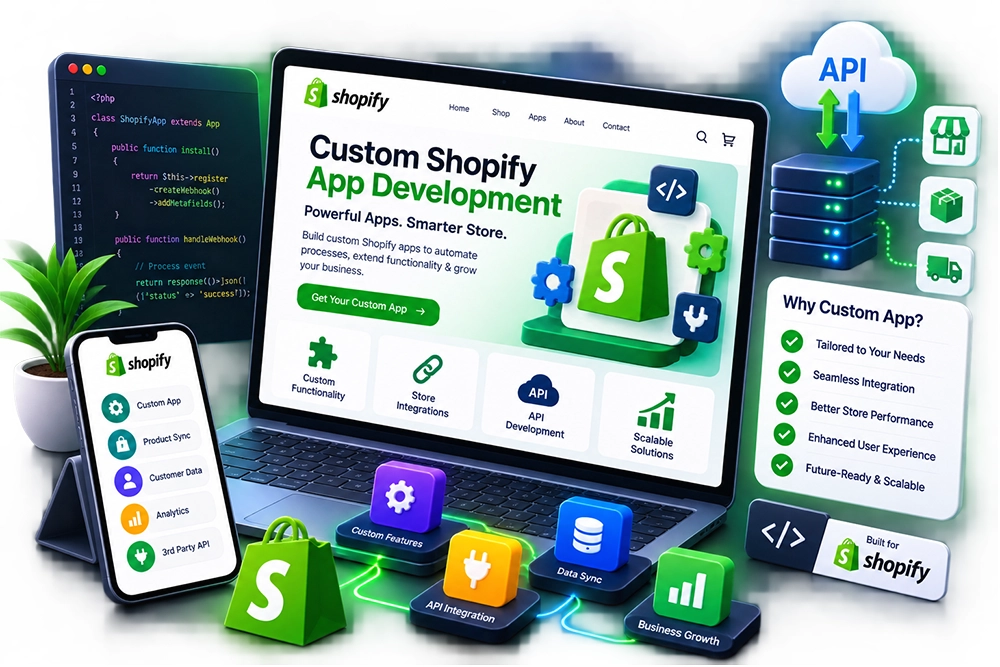
Extend Shopify beyond standard store features with applications built around the way your business actually operates. From custom workflows and system integrations to admin tools, extensions, and merchant-facing functionality, we develop Shopify apps that solve specific operational or customer experience requirements.
Whether the requirement is an internal app for one store, a reusable public application, or functionality that connects Shopify with external platforms, the build starts with the problem the app needs to solve. Architecture, permissions, data handling, user flows, and platform constraints are considered before development begins.
As a Shopify operation becomes more specialized, generic apps and native features may not cover every workflow, integration, data requirement, or merchant process. Teams can end up stitching together multiple tools, repeating manual tasks, or compromising on how the store should function simply because the required capability does not exist in the current setup.
A purpose-built Shopify app can address those gaps more directly. We define the required user flows, data relationships, integrations, permissions, and business logic before implementation, then develop the application around the real task it needs to perform rather than adding features that do not serve a clear operational or commercial purpose.
App requirements can range from a focused internal tool to a broader merchant-facing product. We structure each build around the intended users, Shopify data involved, required integrations, and the workflow the application needs to support.
Build store-specific applications around workflows, business rules, operational needs, or functionality that cannot be handled cleanly through native Shopify settings or off-the-shelf applications.
Develop applications intended for a specific business or store environment, with features shaped around internal processes, permissions, data requirements, and merchant workflows.
Plan and develop reusable applications intended for multiple merchants, with attention to onboarding, permissions, scalable data handling, merchant experience, and platform-specific requirements.
Extend relevant areas of the Shopify experience with supported extensions and embedded functionality where the platform provides an appropriate extension point for the required merchant or customer interaction.
Connect Shopify with external systems such as operational platforms, business tools, internal services, or other APIs when information needs to move between environments without relying on repetitive manual handling.
Create focused tools that simplify recurring merchant tasks, organize store data, support internal workflows, or automate defined processes that would otherwise require unnecessary manual effort.
Custom app projects become unnecessarily complex when development starts before the underlying workflow is understood. We first clarify who will use the application, what information it needs, and what outcome the feature is expected to support.
Requirements are translated into practical application flows before development begins, helping avoid features that add technical scope without improving the process the app was created to support.
Shopify data, permissions, platform capabilities, and external dependencies are considered early so the implementation reflects the environment the application will actually operate in.
Integration requirements are evaluated as part of the wider workflow instead of treating each API connection as an isolated technical task without context.
Merchant and admin interfaces are approached with usability in mind so routine actions remain understandable for the people expected to work with the application after launch.
Application scope stays aligned with defined business needs, reducing unnecessary complexity and making future maintenance or extension easier to reason about.
Testing focuses on real application flows, data behavior, permissions, integrations, and error conditions rather than checking screens in isolation.
App development is broken into discovery, technical planning, implementation, integration, testing, and release stages. This allows business logic and technical decisions to be validated before they become deeply embedded in the build.
We define the users, business problem, required actions, data involved, expected outcomes, and dependencies so the application begins with a clear purpose rather than a vague feature list.
The planned workflow is translated into application components, Shopify interactions, permissions, integrations, data flows, and other technical requirements relevant to the agreed scope.
Core application flows, business logic, merchant-facing interfaces, background processes, and required Shopify interactions are implemented according to the approved architecture.
Required external systems and Shopify services are connected, with attention given to data exchange, authentication, permissions, failure handling, and the way integrations affect the wider application workflow.
Key user journeys, application states, permissions, data behavior, integrations, and error scenarios are reviewed to identify issues before the application is prepared for production use.
After final approval, the application is prepared for its intended environment. Future improvements can be planned as store requirements, workflows, integrations, or merchant needs evolve.
Custom app projects often raise questions about scope, app types, integrations, development cost, ownership, and whether an app is even necessary. These answers cover several practical points worth considering before development starts.
Yes. A custom Shopify app can be developed when your store requires workflows, integrations, admin tools, or functionality that existing platform features and available applications do not address appropriately.
A custom app is generally created for a specific merchant or business environment, while a public app is intended for broader merchant use. The development, onboarding, permissions, and distribution requirements differ according to the intended audience.
Yes, where suitable APIs or supported integration methods are available. An application can exchange relevant data with external services, but the exact approach depends on authentication, data requirements, platform capabilities, and the systems being connected.
Yes. Supported Shopify extension points can be used where they fit the required use case. The appropriate extension type depends on the part of the Shopify experience being extended and the functionality the application needs to provide.
Cost depends on application scope, number of workflows, integrations, user interfaces, data requirements, permissions, background processes, testing needs, and whether the app is intended for one merchant or wider distribution.
A custom app may be appropriate when an important workflow is repeatedly manual, existing apps cannot support the requirement cleanly, or the store needs a specific integration or feature that justifies purpose-built development.
Tell us what the app needs to do, who will use it, and which Shopify or external systems it needs to work with. We can help define the workflow, technical scope, integrations, and application structure before development begins.