
Custom Headless Storefront Development
Build a custom frontend around your brand, catalog, customer journeys, and interaction requirements while Shopify continues to manage the underlying commerce data and operational functions.
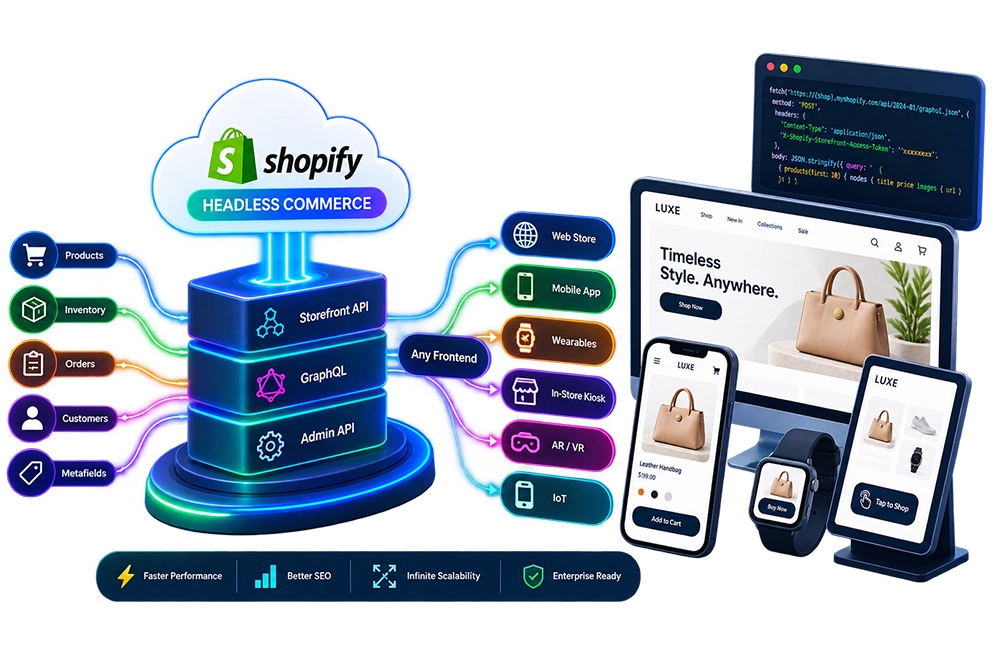
Separate the customer-facing experience from the traditional Shopify theme layer and build a storefront with greater control over performance, content, interaction design, and frontend architecture. A headless Shopify setup can connect custom interfaces with Shopify commerce data while giving teams more freedom over how digital experiences are delivered.
Headless architecture makes the most sense when the storefront needs to go beyond conventional theme limitations. We plan the frontend, APIs, content sources, integrations, and commerce workflows as one connected system so flexibility does not come at the cost of maintainability or operational clarity.
Conventional Shopify themes work well for many stores, but some ecommerce experiences demand more control over frontend behavior, content delivery, application structure, or integration with other digital platforms. As those requirements grow, forcing everything through the theme layer can make development slower, compromise the intended experience, or create awkward workarounds between commerce and content.
Headless Shopify removes that dependency by separating the storefront from the commerce backend. We design the architecture around the frontend experience, Shopify data, content sources, APIs, integrations, and operational workflows so each part of the stack has a clear responsibility instead of becoming tightly coupled to one presentation layer.
Headless commerce is not simply a frontend rebuild. The storefront, commerce APIs, content systems, customer journeys, and connected business services all need to work together as part of one deliberate architecture.
Build a custom frontend around your brand, catalog, customer journeys, and interaction requirements while Shopify continues to manage the underlying commerce data and operational functions.
Connect the frontend with Shopify commerce data using the appropriate storefront APIs so products, collections, carts, customer interactions, and other supported experiences can be delivered through a custom interface.
Combine Shopify commerce with a suitable content management system when marketing teams need greater flexibility over editorial content, campaign pages, storytelling, or structured content outside the traditional theme editor.
Plan reusable components, routing, data fetching, state, rendering behavior, and application structure around the performance and maintainability requirements of the storefront.
Connect the headless storefront with search, personalization, analytics, content, customer-data, or other external services where they support a defined customer or operational requirement.
Develop headless storefronts for more complex Shopify Plus environments where custom experiences, integrations, multiple systems, or broader commerce requirements justify a decoupled frontend.
A headless build introduces more architectural freedom, but it also introduces more responsibility. We first determine whether the added control genuinely supports the business before recommending a stack that is more complex than a traditional Shopify storefront.
The decision to go headless is tied to actual storefront, content, integration, or performance requirements rather than treating newer architecture as an automatic upgrade.
Commerce responsibilities and frontend responsibilities are separated clearly so teams understand which system owns products, content, customer interactions, and other important data.
APIs and external services are selected around defined workflows, reducing the risk of adding unnecessary dependencies that make the storefront harder to operate over time.
Frontend components are planned for reuse and maintainability so future page or experience changes do not require the entire application to be reworked.
Content management is considered alongside commerce architecture, helping marketing and ecommerce teams work within tools appropriate to the type of content they manage.
Performance, resilience, and operational complexity are reviewed as part of the complete system instead of optimizing one layer while creating problems somewhere else in the stack.
The build begins with architecture rather than frontend code. We map customer journeys, content responsibilities, commerce data, integrations, rendering needs, and operational constraints before turning those decisions into the headless application.
We review the current storefront, customer experience goals, content requirements, integrations, technical constraints, and expected benefits to determine whether headless architecture is appropriate for the project.
Frontend responsibilities, Shopify APIs, content systems, third-party services, data flows, deployment needs, and integration boundaries are defined before implementation begins.
Reusable storefront components and customer-facing interfaces are developed around the approved experience, responsive requirements, content structure, and commerce interactions.
The frontend is connected with Shopify and any agreed CMS or external services, bringing together catalog data, content, carts, navigation, and other required storefront experiences.
Key customer paths, API behavior, responsive layouts, content delivery, integrations, and failure scenarios are reviewed to identify issues across the full headless experience.
After approval, the application is prepared for production use. Components, integrations, content workflows, and architecture can then evolve as new storefront and commerce requirements emerge.
Headless projects raise important questions about architecture, APIs, content management, performance, checkout, Shopify Plus, and cost. These answers cover the considerations that usually matter before deciding whether to decouple the storefront.
Headless Shopify separates the customer-facing frontend from Shopify's traditional theme layer. Shopify continues to provide commerce capabilities, while a custom frontend uses supported APIs to present products, content, carts, and other storefront experiences.
Headless architecture may be worth considering when a store needs substantial frontend flexibility, complex content experiences, specialized integrations, or application behavior that is difficult to achieve cleanly within a conventional theme.
Yes. A headless storefront can combine Shopify commerce with a separate content management system when the project requires more flexible editorial or structured content workflows. The appropriate setup depends on the content and operational requirements.
The specific APIs depend on the required experience and current Shopify capabilities. Storefront-facing commerce data is typically accessed through supported storefront APIs, while additional systems may use other appropriate Shopify interfaces.
Shopify Plus can be part of a headless architecture where the business requires a custom frontend combined with more complex commerce operations, integrations, or broader platform requirements. The architecture should be planned around the actual use case.
Cost depends on frontend complexity, number of templates and components, content systems, APIs, integrations, rendering requirements, testing, hosting and deployment needs, and the scope of ongoing application maintenance.
Share the storefront limitations, content requirements, integrations, and experiences you want to improve. We can assess whether headless architecture is the right fit and map the frontend, APIs, CMS, and technical structure before development starts.