
Custom API Connections
Connect Shopify with supported external APIs for business-specific workflows, allowing relevant data and actions to move between systems according to defined rules and use cases.
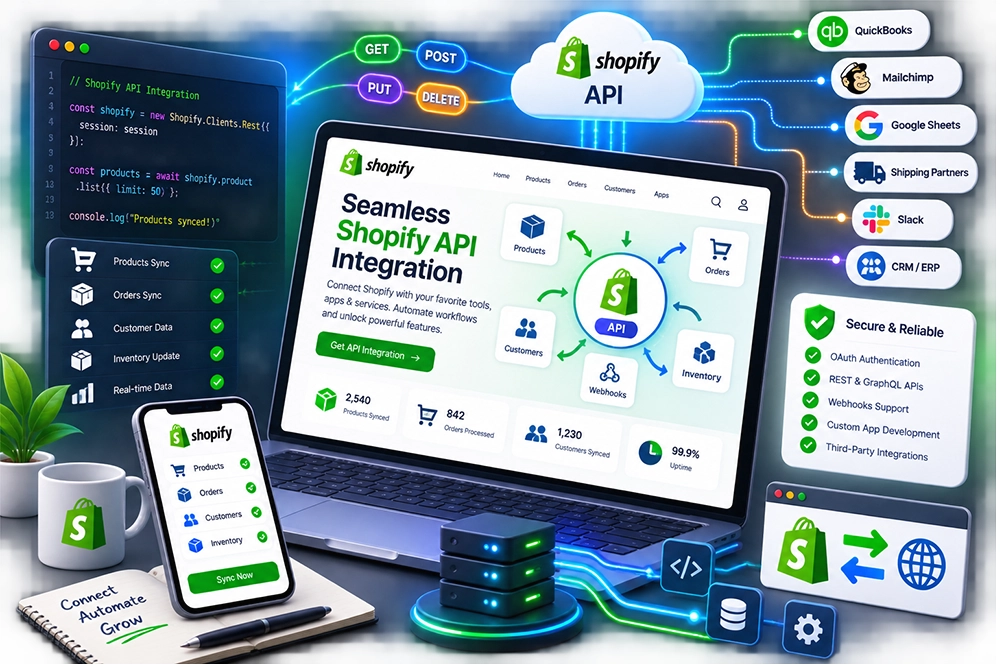
Connect Shopify with the systems your business depends on, from inventory and fulfillment platforms to payment tools, customer data, tracking services, internal applications, and external APIs. We plan integrations around the information that needs to move, the actions that need to happen, and the systems responsible for each part of the workflow.
Instead of treating an API connection as a simple technical link, we look at authentication, data mapping, synchronization, error handling, permissions, and operational dependencies before implementation. This creates an integration that supports the wider ecommerce process rather than becoming another disconnected layer to manage.
Ecommerce operations often rely on more than Shopify alone. Inventory may live in one system, fulfillment in another, customer data somewhere else, and reporting or internal workflows in separate tools. When those platforms do not exchange information reliably, teams can end up re-entering data, reconciling mismatches, or depending on manual processes that become harder to manage as transaction volume grows.
API integration creates a controlled way for those systems to communicate. We identify the information each platform owns, determine what needs to move between them, define triggers and synchronization rules, and implement the connection with attention to authentication, permissions, failures, and data consistency across the wider workflow.
Integration requirements differ according to where data originates, how frequently it changes, and what each connected platform needs to do with it. We structure the connection around the actual business flow rather than assuming every integration is simply a two-way sync.
Connect Shopify with supported external APIs for business-specific workflows, allowing relevant data and actions to move between systems according to defined rules and use cases.
Synchronize relevant product, variant, inventory, or catalog information between Shopify and external systems where coordinated merchandising and stock data are required.
Pass applicable order, fulfillment, shipment, or status information between Shopify and operational platforms so downstream processes can respond to storefront activity more efficiently.
Integrate supported payment-related services or transaction workflows where Shopify needs to exchange information with an external payment or financial system within platform constraints.
Connect relevant analytics, tracking, customer-data, or reporting services when store events and ecommerce information need to be passed into another platform for measurement or processing.
Link Shopify with internal business applications, middleware, or operational systems when teams need store data to participate in workflows beyond the ecommerce storefront itself.
The difficult part of integration is rarely the API request itself. Problems usually appear when two systems disagree about which one controls a field, when updates happen in the wrong order, or when failures are not handled clearly. We address those questions before the connection becomes part of day-to-day operations.
Data ownership is defined for important fields and records so connected systems do not continually overwrite one another or create conflicting versions of the same information.
Integration flows are planned around real business events and dependencies instead of connecting endpoints without understanding when information should move and why.
Authentication, permissions, and access requirements are considered as part of the architecture so the integration uses appropriate platform capabilities from the beginning.
Error and failure scenarios are taken into account because production integrations need a sensible response when an external service is unavailable or returns unexpected data.
Synchronization frequency and direction are matched to the use case rather than forcing unnecessary real-time behavior into workflows that do not require it.
The completed integration is evaluated within the wider ecommerce operation so technical connectivity supports the process instead of creating a new dependency that teams struggle to manage.
Integration work moves from understanding the business process into data mapping, technical design, implementation, validation, and production monitoring considerations. Each stage reduces ambiguity before the connected systems begin exchanging live information.
We identify the platforms involved, relevant users, existing processes, information sources, business triggers, and expected outcomes before defining how the connection should behave.
Available endpoints, objects, fields, identifiers, permissions, and external API capabilities are reviewed to determine how information can be represented and exchanged between systems.
We define data direction, triggers, synchronization behavior, authentication, transformation requirements, and failure handling before implementation begins.
The agreed integration is built and connected with the necessary Shopify and external API services, including the logic required to transform, validate, route, or synchronize data.
Key integration scenarios are tested using relevant records and events to identify mapping, synchronization, authentication, duplication, or error-handling issues before production use.
After approval, the integration is prepared for its intended environment. Important logs, error conditions, operational dependencies, and future maintenance requirements can then be reviewed as part of ongoing system management.
API projects often depend on platform permissions, available endpoints, data ownership, synchronization needs, and the capabilities of the external system. These answers cover several practical considerations before integration work begins.
Yes, where Shopify and the external service provide suitable APIs or supported integration methods. The exact implementation depends on authentication, available endpoints, required data, permissions, and the business workflow being connected.
Shopify can potentially be connected with inventory systems, fulfillment platforms, internal applications, customer-data tools, reporting services, payment-related systems, catalogs, and other platforms that expose suitable integration capabilities.
Yes, depending on the source system and available APIs. Product, variant, catalog, and inventory information can be synchronized according to defined ownership, mapping, and update rules.
Yes. Applicable order, fulfillment, shipment, or status information can be exchanged with external operational systems when supported APIs and permissions are available.
Not always. Some workflows benefit from near-real-time events, while others are better suited to scheduled or event-based synchronization. The appropriate model depends on how quickly each system needs the updated information.
Cost depends on the number of systems, API complexity, authentication requirements, data mapping, synchronization logic, transformations, error handling, testing scope, and any middleware or custom application work required for the integration.
Tell us which platforms need to exchange data, what information should move between them, and which workflows depend on the connection. We can map the API requirements, data ownership, synchronization rules, and integration logic before implementation begins.